


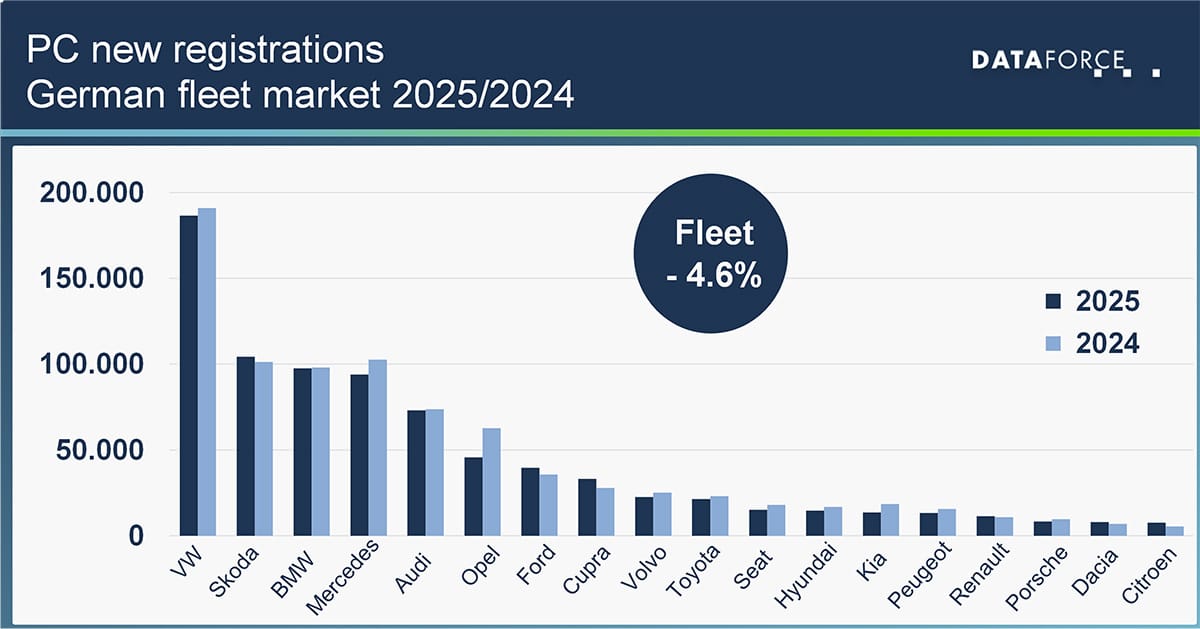
- Slightly lower new fleet registrations in a modestly growing overall market
- Strong year-end rally for electric models
- BEVs set to become the number one fuel type in 2026
German passenger car fleet market: the 2025 review
With December registrations now available and 2025 complete, it is time to draw an initial balance. While the overall market recorded growth of 1.4 percent thanks to a strong second half of the year, the fleet market closed with a decline of 4.6 percent. At first glance, this may appear a bit sobering. However, there have only been three years to date (2019, 2023 and 2024) with a higher volume in this sales channel. In that respect, there is little reason for either euphoria or major disappointment.
Despite the market decline, several brands managed to increase their own volumes with fleet customers. Within the top 10, Ford (position 7, +11.3%), Cupra (P8, +19.0%) and Skoda stood out, with the latter moving into second place behind market leader VW on the back of 3.0 percent growth. VW sales were slightly down at -2.3%. With a market share of 21.5%, however, the Wolfsburg-based brand achieved its highest full-year fleet share since 2016. That perhaps makes it easier to accept that the crown of the most successful fleet model went to Skoda – unsurprisingly, the Octavia.
Fully electric models made a significant contribution to the strong performance of both VW and Skoda. Here, the ID.7 clearly led the way, followed by the Skoda Enyaq, VW ID.3 and ID.4. Behind the BMW iX1, further Volkswagen Group models rounded out the top eight, including the Skoda Elroq, Audi A6 e-tron and Audi Q6 e-tron.
How are the newcomers performing?
Overall, there were only minor shifts in the brand ranking compared with the previous year. For new (Chinese) manufacturers, it remains difficult to gain a foothold in this demanding True Fleets market – if that is even the goal. An analysis of the “newcomers” reveals very different outcomes in this regard. While brands like Leapmotor or Dongfeng had three out of four new registrations coming from private customers, the share of fleet customers at Polestar exceeds 50 percent. BYD stands at 14 percent, which is at least higher than, for example, MG.
Staying with Chinese manufacturers, there is another noteworthy insight. The EU tariffs that are still in place on electric vehicles produced in China and imported into Europe are clearly reflected in the powertrain mix of some brands. Those with suitable models in their portfolios are able to “divert” volume and bring a higher share of non–fully electric vehicles to market. MG is a typical example of this. Of MG’s fleet registrations in 2025, “just” 40 percent were BEVs. Plug-in hybrids and full hybrids accounted for 23 percent and 22 percent respectively, with a further 15 percent made up of petrol vehicles. Of course, competitors such as Leapmotor, Polestar or Nio are exclusively electric, but the simple equation of Chinese brand equals electric clearly falls short.